Email marketing in Spanish: what works and what falls flat
Email still delivers the highest return on investment of any digital marketing channel. That is true in Spain as much as anywhere else.
Here is a scenario that plays out more often than you’d think:
A brand with a solid English email programme decides to expand into Spain. They translate their existing sequences. Open rates look okay. But click-throughs are low, unsubscribe rates are higher than expected, and the Spanish campaign just never quite performs the way the English one does.
Sound familiar? The campaign is not underperforming because Spaniards don’t read email. It’s underperforming because email marketing in Spanish requires more than running your existing sequences through a translation tool. 📧
- How Spanish audiences respond to email communication
- Formal vs. informal: navigating the tú and usted distinction
- Subject lines that work in Spanish
- Common mistakes in automated Spanish email sequences
- How to adapt your welcome sequence for Spanish subscribers
How Spanish audiences respond to email communication
Spanish email readers, like readers anywhere, are protective of their inboxes. But the triggers that earn trust — and those that create scepticism — follow slightly different patterns from English-speaking markets.
Spanish consumers tend to respond well to a direct, personal tone. An email that reads as if it was written by a human, for a human, performs better than one that reads like broadcast marketing.
The preference for personal communication means that:
- Using the reader’s first name
- Writing in a conversational register
- Acknowledging real-world context
…all carry more weight than in markets where a formal, media-style approach is the norm.
At the same time, aggressive sales techniques and artificial urgency are viewed with particular scepticism in Spain. 🇪🇸 Spanish consumers are savvy about marketing conventions and disengage quickly when they sense manipulation rather than genuine communication.
The brands that do well in Spanish email marketing tend to share a common approach: they write as if they are a knowledgeable, trusted colleague — not as if they are running a limited-time sale.
Formal vs. informal: navigating the tú and usted distinction
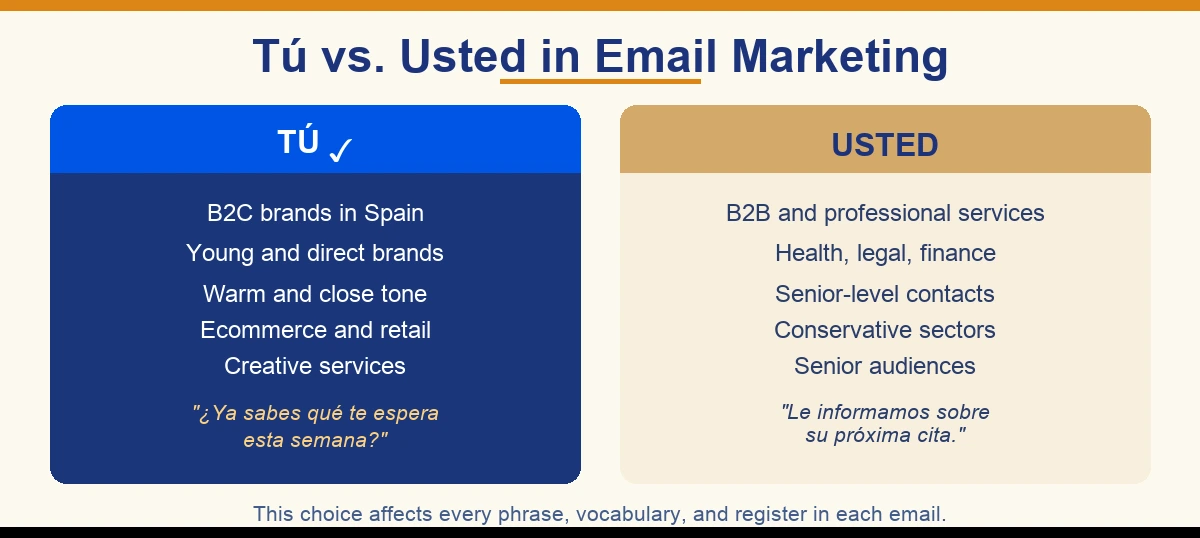
The tú/usted decision is the first and most consequential tone choice in any Spanish email marketing programme. It affects every sentence in every email, and inconsistency — switching between the two without reason — is immediately noticeable and feels unprofessional.
Think of it like suddenly switching from “you” to “thou” halfway through an email. That’s roughly how jarring it feels to a native Spanish reader.
For most B2C brands in Spain, tú is the correct choice. It is warmer, more direct and matches the register that most Spanish consumers use in their own communication. Using usted in a direct-to-consumer context can come across as either overly formal or as a brand that hasn’t thought carefully about who it is talking to.
For B2B brands — especially in professional services, financial services, legal or healthcare sectors — usted may be more appropriate depending on the seniority of the contacts and the specific brand voice.
One practical note that many brands miss: the decision is not just about verb conjugations. It shapes the vocabulary choices, the sentence rhythm and the overall register of every email. It needs to be decided deliberately before a single line is written. ✍️
Subject lines that work in Spanish
Email subject lines in Spanish follow some of the same principles as English ones, but with important differences.
Specificity works. ✅ Vague subject lines underperform in Spanish just as they do in English.
- News from us → gets deleted
- Three things that are making your Spanish website lose clients → gets opened
Questions work, but need to be genuine ones. ✅ A question that clearly exists only to trigger curiosity — with no real answer in the email — trains readers to distrust your subject lines quickly. A question you actually answer, with relevant content, builds the kind of trust that keeps open rates healthy over time.
Urgency needs to be real. ✅ Spanish readers are particularly attuned to manufactured urgency. “Last chance” for an offer that reappears next week is noticed and remembered. Real deadlines and real limitations, communicated honestly, work well.
Conversational beats corporate. ✅
“Cómo saber si tu copy en español está fallando” tends to outperform “Optimising your Spanish content performance” — even when both refer to the same content.
Write subject lines the way a knowledgeable friend would write them. Not a marketing department.
Common mistakes in automated Spanish email sequences
Automated sequences present specific challenges for Spanish localisation because errors compound over time. A welcome sequence with a slightly off tone will affect the reader’s relationship with the brand across all subsequent emails.
The most common mistakes: 🚩
Translating the English sequence without adapting the trust-building structure. English email sequences often lead with authority and social proof early. Spanish sequences tend to work better when they invest more in establishing the human behind the brand before moving to credibility signals. The structure that works in English may need reordering for a Spanish audience.
Using the wrong register for the category. A tech startup that sounds appropriately casual in English can sound unprofessional if the same casualness is applied without adaptation in Spanish. And a traditional services firm that sounds appropriately formal in English can sound cold and off-putting in Spanish if the formality is maintained at the same level.
Missing cultural references. If your English sequences reference things that are specifically American or British in their cultural context, those references need replacing rather than translating. A “Thanksgiving sale” doesn’t land in Spain — not because Spaniards don’t like discounts, but because it signals that the email wasn’t written for them. 🎃
How to adapt your welcome sequence for Spanish subscribers
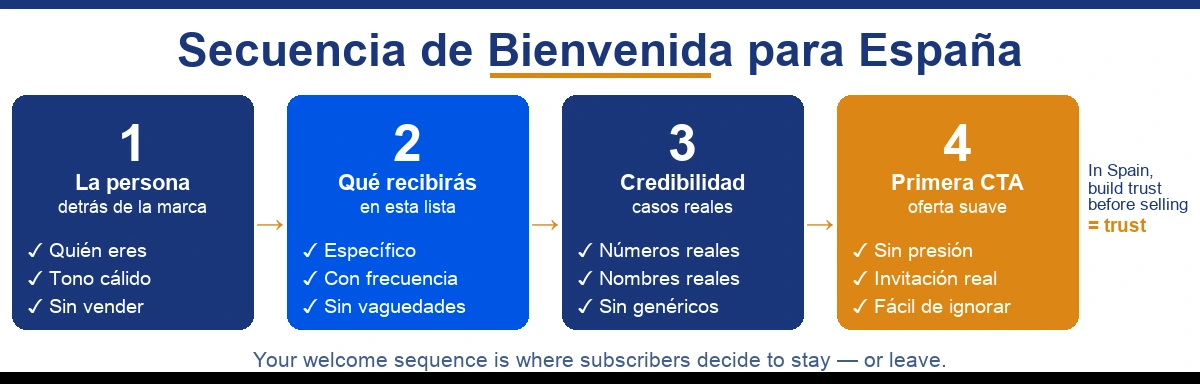
The welcome sequence is where the relationship starts. In Spanish markets, this is where the decision to stay subscribed or unsubscribe is largely made.
A welcome sequence adapted for Spain typically:
Introduces the human behind the brand within the first email, with warmth and directness rather than corporate positioning. Spanish subscribers respond well to knowing who they are hearing from. Not “Welcome to our newsletter.” More like: Hi, I’m Víctor. Here’s why I started this…
Leads with what the subscriber will actually get, in specific, practical terms. Compare these two approaches:
❌ Stay updated with our latest insights.
✅ You will receive one email per month with three actionable ideas for improving your Spanish marketing.
The second version is what converts in Spain.
Waits to establish credibility before asking for anything. The trust-building phase is longer in Spain than in some other markets. A welcome sequence that moves quickly to a sales ask tends to see higher unsubscribes. Earn the relationship first. 🤝
Uses real examples, real numbers and real stories rather than generic claims. Working with brands like X and Y, we have seen that… is far more credible in Spanish communication norms than we help brands achieve outstanding results.
The principle across all of these is the same as in the rest of Spanish email marketing: write for a specific human, in a specific context, with genuine respect for their time and intelligence.
The technical side of email — deliverability, timing, automation — is largely the same as in English. The copy is what makes or breaks it.
Want to keep improving your Spanish marketing? The Copybara newsletter covers bilingual copy, localisation strategy and real examples. Subscribe here to get it straight to your inbox.