Spain Spanish vs. Latin American Spanish: which one does your brand need?
Spanish is the second most widely spoken language in the world by number of native speakers. But “Spanish” is not a single, uniform thing.
Here is a scenario that plays out constantly:
A brand launches in Spain using the Spanish content they already created for their Mexican market. The copy is technically correct. A Spanish consumer reads it. Something feels slightly off. They can’t quite put their finger on it. But they move on to the competitor whose content feels like it was written for them.
This is the cost of not choosing the right variant. It is not dramatic. Nobody is offended. Nobody writes a complaint. The content just underperforms in ways that are hard to attribute but very real. 🎯
- Key vocabulary differences between Spain and Latin America
- Tone, formality and regional preferences
- Why using Latin American Spanish for a Spanish audience can backfire
- How to decide which variant your brand needs
- Can one copywriter handle both?
Key vocabulary differences between Spain and Latin America
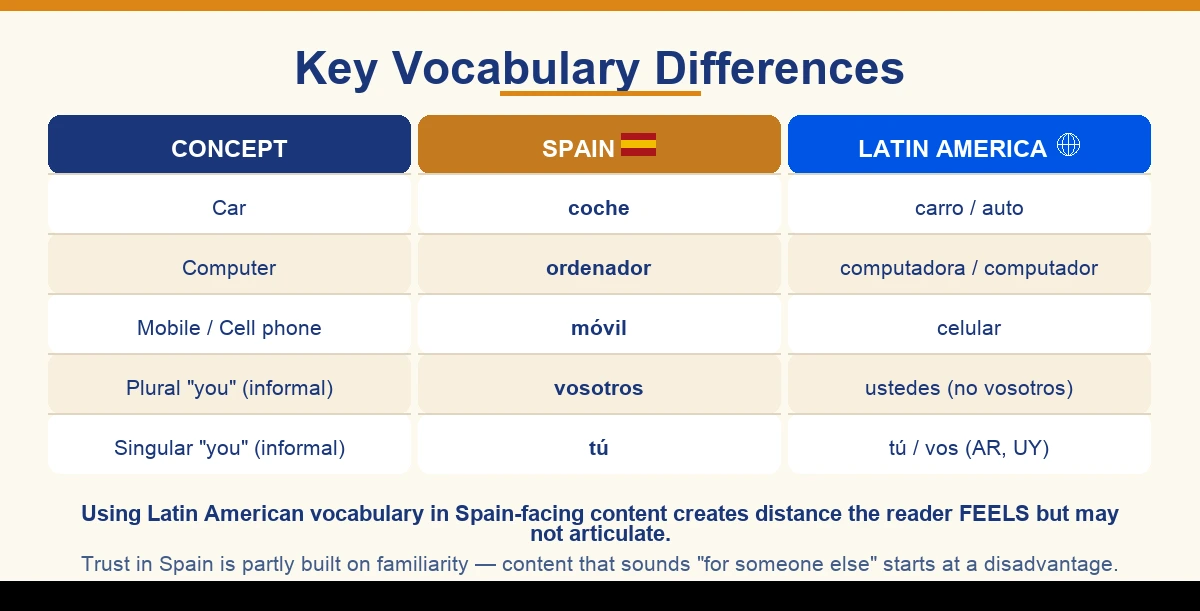
Some of the vocabulary differences are well known even outside Spanish-speaking communities:
| Concept | Spain 🇪🇸 | Latin America 🌎 |
|---|---|---|
| Car | coche | carro / auto |
| Computer | ordenador | computadora / computador |
| Mobile phone | móvil | celular |
| Plural “you” (informal) | vosotros | ustedes |
But the differences go further than the most famous examples. In marketing and commercial copy specifically, the vocabulary choices signal cultural alignment. Using Latin American vocabulary in Spain-facing content — even once or twice — creates a sense of distance in the reader that they may not consciously identify but will feel.
The grammatical differences are equally significant:
Spain Spanish uses vosotros as the informal second-person plural — a form that does not exist in most Latin American Spanish. A piece of Spanish content that avoids vosotros entirely reads to a Spanish person as Latin American, regardless of any other vocabulary choices.
The tú/vos distinction is another marker. Some Latin American countries — particularly Argentina and Uruguay — use vos instead of tú as the informal second-person singular. This is entirely unknown in Spain, and its appearance in Spain-facing content creates an immediate sense of foreignness. 👀
Tone, formality and regional preferences
Beyond vocabulary and grammar, the cultural norms around formality differ significantly between Spain and Latin America.
Spain Spanish tends to be more direct. Spanish speakers in Spain are generally comfortable with a level of directness in commercial communication that some Latin American cultures would consider slightly abrupt.
Latin American Spanish, particularly in formal writing and marketing copy, sometimes leans toward a more elaborate formality that sounds archaic to Spanish ears. The register that works for a professional services pitch in Colombia is different from what works for the same pitch in Madrid.
These are generalisations — there is significant variation within Latin America itself. But for a brand targeting Spain specifically, the relevant benchmark is Spanish communication norms, not a pan-Latin American average.
Why using Latin American Spanish for a Spanish audience can backfire
The practical risk is not that Spanish readers will be offended or unable to understand Latin American Spanish. They will understand it perfectly. The risk is subtler: the content will feel slightly foreign, slightly off, in a way that the reader may not consciously articulate but that affects their response to the brand.
Trust in Spain, as in most markets, is partly built on familiarity. A brand that sounds like it is for someone else — like it was written for a general international Spanish-speaking market rather than for this specific country and culture — starts at a disadvantage. 🚩
This effect is stronger in some categories than in others:
- Consumer goods with broad appeal: the effect may be minimal
- Professional services, financial services, or any category where trust and cultural familiarity are directly related to conversion: the effect can be significant
Several international brands that entered Spain with Latin American Spanish content — typically because they already had that content from other market entries — found that performance in Spain lagged notably behind markets where they had invested in Spain-specific content. When they reinvested in Spain Spanish localisation, the gap closed.
How to decide which variant your brand needs
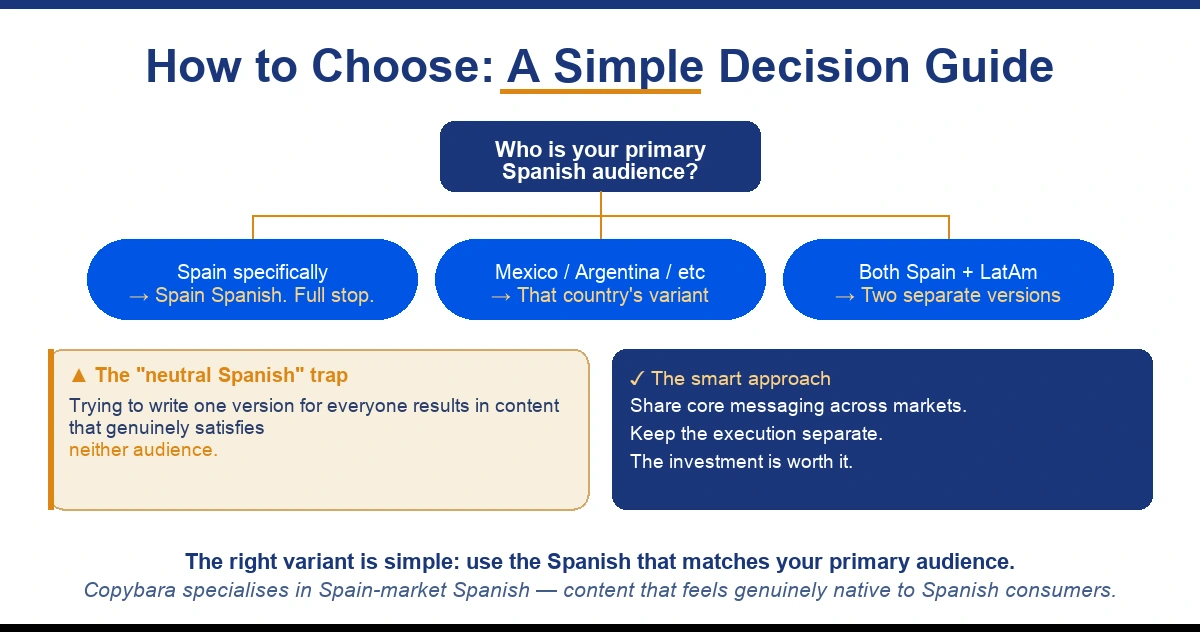
The decision is simple in one respect: use the Spanish that matches your primary audience.
- Targeting Spain? → Spain Spanish. Full stop.
- Targeting Mexico? → Mexican Spanish.
- Targeting broad international Spanish-speaking audiences? → The decision is more nuanced.
The complications arise when brands try to produce a single piece of content that works for both Spain and Latin America. This is sometimes possible for general informational content — if you choose vocabulary that is recognisable in both markets and avoid the grammatical markers (vosotros, vos) that are specific to one. It is rarely possible for brand-facing copy, where tone, idiom and cultural register matter too much to produce a genuinely neutral version.
If you need to reach both markets, the most effective approach is to produce distinct versions for each. The core messaging can be shared. The execution should be separate.
Can one copywriter handle both?
Some bilingual copywriters have deep expertise in both Spain Spanish and one or more Latin American Spanish variants. This is not the default. Spain-based copywriters typically specialise in Spain Spanish, and Latin American copywriters typically specialise in their own country or region.
If you need content for both markets, look for a copywriter or agency that is explicit about which variants they cover and can provide examples of work in each. The worst outcome is a copywriter who writes a single “neutral” Spanish that satisfies neither audience fully. 😬
Copybara specialises in Spain-market Spanish — content for the Spanish market that feels native, uses the correct vocabulary and grammar, and is calibrated to the specific cultural expectations of Spanish consumers. For Latin American markets, we can advise on strategy and brief structure, and we work with trusted partners where production in specific variants is required.
For more on the practical implications of getting the Spanish market right, see our guide on how to enter the Spanish market with the right messaging and our article on why your Spanish marketing is not working.
Want to receive more resources on Spanish-market content strategy? The Copybara newsletter covers this and more. Subscribe here.